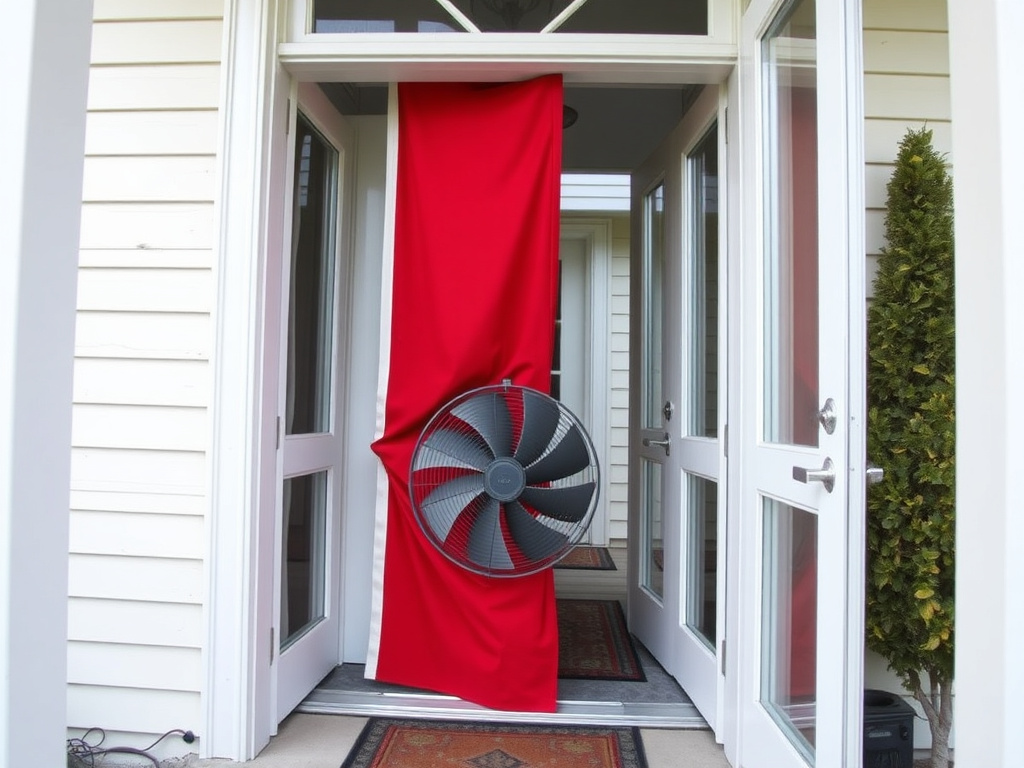
Your blower door test comes back with one headline number: ACH50, air changes per hour at 50 Pascals of pressure. On its own, that number is close to meaningless — a 1962 ranch house and a 2022 production build should never be judged against the same target, and a report that just hands you a single figure without context leaves you no better equipped to act on it than before the test.
This guide walks through how the test actually works, what a realistic “good” score looks like once you account for your home's age and construction, what a high number is actually costing you every year in wasted energy, and what to expect when you re-test after air sealing work is complete.
How the Test Actually Works
A blower door is a calibrated fan mounted in a temporary frame that seals into your front doorway. The fan depressurizes the house to 50 Pascals — roughly the pressure created by a 20 mph wind hitting every side of the house at once — while a digital manometer measures how much air, in cubic feet per minute (CFM50), has to be pulled out of the house to hold that pressure steady. More air pulled out means more air leaking back in through cracks, gaps, and penetrations somewhere in the building envelope.
That raw CFM50 figure is then divided by your home's conditioned volume — the total cubic footage of the space actually being heated and cooled — and converted to ACH50, air changes per hour. That conversion is what lets a 900-square-foot bungalow and a 4,000-square-foot two-story home be compared meaningfully on the same scale, instead of the larger home automatically scoring worse simply because it has more total surface area for leaks to occur.
A complete test also standardizes conditions before the fan starts: interior doors are typically left open, exterior dampers and fireplace flues are closed as they would be in normal winter use, and the technician notes outdoor wind and temperature, since both can influence the reading. This standardization is what makes a pre- and post-retrofit comparison valid — without it, you'd never know whether a lower second-test number reflected real sealing work or just calmer weather on test day.
What's a “Good” Score, by Construction Era?
Building codes have tightened air-sealing requirements substantially over the decades, so a score that would be alarming in a 2022 build is often unremarkable in a mid-century house that was never built to any leakage standard at all. The ranges below are general benchmarks, not hard pass/fail thresholds — your specific home's realistic target also depends on climate zone and size, but construction era is the single biggest factor in what counts as normal:
| Construction Era | Typical ACH50 Range | General Read |
|---|---|---|
| Pre-1980 | 10–20+ | Little to no air-sealing standard existed at construction |
| 1980–2000 | 7–14 | Moderate leakage, wide variation by builder and region |
| 2000–2010 | 5–9 | Codes begin tightening envelope and air-sealing requirements |
| 2010–2020 | 3–6 | Mandatory blower door testing common under IECC code paths |
| Post-2020 | Under 3 | Tightest current code thresholds, often ENERGY STAR-verified |
As a rough rule of thumb across all eras: under 3 is excellent by any current standard, 3–7 is average-to-good depending on your home's age, and anything above 10 usually signals real, fixable envelope leakage that's worth prioritizing regardless of when the house was built. A number that falls right at the top of the “typical” range for your era isn't necessarily a problem — but it's also not the same as a genuinely tight envelope, and it's worth asking your auditor which specific bypasses are driving the number up.
What a Bad Score Actually Costs You Every Year
Air leakage isn't just a comfort issue — every cubic foot of conditioned air that leaks out of your home has to be replaced by unconditioned outside air, which then has to be heated or cooled again from scratch. On an older home testing above 12 ACH50, that leakage pathway alone can plausibly account for a meaningful share of total annual heating and cooling spend, independent of how much insulation is already in the walls and attic.
That last point is worth sitting with: two homes with identical insulation levels can post meaningfully different utility bills purely because of a difference in ACH50, since insulation only slows conductive heat loss through walls and ceilings — it does nothing to stop air physically moving through a gap. A well-insulated but leaky house is often described as “a sweater with the zipper down” for exactly this reason: the material is doing its job, but the air is bypassing it entirely through an opening insulation was never designed to address.
This is also why an ACH50 number belongs in the same conversation as your utility bill rather than filed away as an abstract test score. A homeowner comparing a 14 ACH50 baseline against a realistic 6–7 ACH50 target for their era isn't just chasing a better number on a report — they're looking at a specific, quantifiable slice of their annual energy spend that a sealing project can plausibly recover, which is exactly the kind of number a payback- period calculation needs to be useful rather than theoretical.
Put a rough dollar figure on it and the case gets easier to act on. Take a 2,000-square-foot home with a $2,400 annual heating and cooling bill testing at 14 ACH50, well above the 6–7 range typical for its era. If air leakage is responsible for even a third of that spend, sealing the envelope down toward a realistic 7 ACH50 target could plausibly recover several hundred dollars a year in wasted conditioned air — money that's currently leaving through gaps around rim joists, attic hatches, and can lights rather than through the thermostat setting. That's before factoring in any rebate or tax-credit dollars that reduce the project's net cost further, which is exactly the kind of number a diagnostic-grade audit is built to put in front of you instead of leaving you to guess.
It's also worth remembering that a high ACH50 score compounds with equipment inefficiency rather than sitting apart from it. An aging furnace or air conditioner already working harder than a newer unit has to work harder still on a leaky house, since a share of every heating or cooling cycle is being spent conditioning air that immediately escapes. Homeowners planning an HVAC replacement often get more total value by sealing the envelope first — a properly sized new system installed against a tighter envelope runs shorter cycles, sees less wear, and can sometimes be downsized from what a leaky-envelope load calculation would otherwise call for.
Why Your Number Might Come Back Different Than Expected
- Interior doors and dampers were left in unusual positions — a proper test protocol standardizes these before depressurization begins, and a skipped step here can meaningfully skew the reading.
- Weather conditions on test day — high wind can affect baseline pressure readings even with a calibrated blower door correcting for it, which is why technicians log wind and temperature alongside the result.
- Recent renovation work opened new penetrations — electrical, plumbing, or HVAC — that weren't fully re-sealed after the trade finished the job.
- The home is larger or smaller than assumed — conditioned volume calculations directly affect the ACH50 conversion from the raw CFM50 measurement, so an inaccurate square-footage figure will skew the final number even if the raw airflow reading was correct.
How Sealing Work Changes the Number on Re-Test
A pre-retrofit blower door test identifies how much air is leaking in total; complementary thermal imaging, run at the same visit, pinpoints where. Air sealing contractors then target the specific bypasses both tests flagged — top plates, recessed can lights, attic hatches, rim joists, and duct chases are consistently the most common offenders across home types and climates.
A re-test after the work is complete is the only objective way to confirm the sealing actually worked, rather than relying on a contractor's description of what was done. It's also the exact documentation utility rebate programs and the HOMES performance rebate require to calculate your incentive dollars — without a documented before-and-after pair, several of the larger available rebates simply aren't reachable no matter how thorough the actual work was. It's common to see a 30–50% reduction in ACH50 from a well-executed, diagnostically-targeted air sealing project, though the exact figure depends heavily on how leaky the starting point was and how many of the flagged bypasses were addressed.
One safety note worth flagging here: any time air sealing meaningfully tightens a home's envelope, diagnostic-grade practice calls for a combustion safety check on fuel-burning appliances as part of the same project, not as an afterthought. A tighter envelope changes how those appliances draft, and a responsible sealing project folds that verification into the scope rather than treating it as optional. A complete post-retrofit report should show a passing combustion safety result sitting right alongside the improved ACH50 figure.
Reading Your Score Alongside Climate and Home Size
Construction era is the biggest factor behind a realistic ACH50 target, but it isn't the only one. Homes in colder climate zones are typically built with tighter air-sealing detailing even within the same code era, since the cost of leakage is more severe over a longer heating season — a mild-climate home at the same age and ACH50 score may be losing less total energy than the number alone would suggest. Larger homes also tend to test slightly higher on raw ACH50 than smaller homes of identical construction quality, simply because more total envelope area and more penetrations for plumbing, electrical, and HVAC runs create more opportunities for leakage, even when the workmanship is comparable.
None of this means the benchmark table above stops being useful — it means a diagnostic-grade auditor should be reading your number in the context of your specific climate zone and square footage, not applying a single flat target regardless of where or how big your home is. If your report gives you a bare ACH50 figure with no discussion of what's realistic for your specific home, that's a reasonable thing to ask about before you act on the recommendation list that follows it.